Affiliate Disclosure: We may earn a commission if you purchase through our links, at no extra cost to you. Our editorial selections are independent.
A mandoline slicer does in seconds what a knife does in minutes, and it does it with a consistency no hand-slicing technique can reliably replicate. The uniform cut thickness that a mandoline produces — 1mm, 2mm, 3mm, regardless of how tired your arm is — directly affects how food cooks, how produce ferments, and how gratin and salad presentations look. For lacto-fermentation specifically, consistent shred width across a whole head of cabbage produces even salt penetration and predictable brine formation. For everyday cooking, a mandoline transforms cucumber salads, potato gratins, fennel slaws, and zucchini ribbons from laborious to effortless. In 2026, the market ranges from simple handheld models to 12-blade pro-series slicers. We evaluated six options for blade quality, safety features, thickness adjustment, and real-world kitchen utility.
Quick Comparison
Product
Best For
Key Feature
Top Con
Link
Mueller Pro-Series 12-Blade Mandoline Slicer with Container
Best Overall
12 blade types cover slicing, julienne, dicing, and waffle cuts for full vegetable versatility
12 blades require organized storage to prevent dulling and to locate the right insert quickly
Pro Tip: Core cabbage completely before using a mandoline — the dense core can grip the blade unevenly and cause dangerous slippage mid-stroke.
1.EDITOR'S PICK
Mueller Pro-Series 12-Blade Mandoline Slicer with Container
A 12-blade professional mandoline with an integrated collection container — offering the widest blade variety in its category alongside practical features like a catch container that eliminates separate bowls.
Considerations
12 blades require organized storage to prevent dulling and to locate the right insert quickly
More complex setup than simple handheld models — takes a few sessions to become fluent
12 blade types cover slicing, julienne, dicing, and waffle cuts for full vegetable versatility
Integrated collection container eliminates the need for a separate bowl during prep
Non-slip base and hand guard included as standard — complete safety setup out of the box
Adjustable thickness settings provide precise control over cut dimensions
Dedicated home cooks who want a full-featured mandoline for slicing, julienning, and dicing a wide range of vegetables with precise thickness control and integrated catch container.
Select and install the appropriate blade insert, set your desired thickness, and use the hand guard to pass food over the blade with smooth, consistent strokes. The catch container below collects sliced food cleanly.
Fullstar 8-in-1 Vegetable Chopper & Mandoline with Container
An 8-in-1 vegetable chopper and mandoline combination with a generous catch container — a multi-function prep tool that handles chopping, slicing, and dicing without requiring multiple separate tools.
Considerations
Chopper function is optimized for softer vegetables — harder root vegetables require more force
Container lid creates extra parts to keep track of in a busy kitchen drawer
8 interchangeable blades handle chopping, dicing, slicing, and julienne in one compact unit
Large catch container with lid doubles as a storage vessel after prep
Non-slip suction base keeps the unit stable during vigorous chopping
BPA-free construction with food-safe materials throughout
Home cooks who want to replace multiple prep tools — chopper, dicer, and mandoline — with a single multi-function unit that minimizes drawer clutter and setup time.
Choose your blade insert, position the container below, use the hand guard or pusher to process vegetables, and store leftovers in the same container with the lid attached. Disassemble completely for dishwasher cleaning.
Mueller Vegetable Chopper Mandoline with Container
Mueller's updated vegetable chopper and mandoline with a large-capacity container and an improved pusher mechanism — a reliable workhorse for batch vegetable prep and fermentation slicing.
Considerations
Assembly of multiple blade inserts can be confusing initially without the instruction guide
Container is large — takes meaningful dishwasher space when cleaning after batch prep
Large container capacity handles batch prep for meal prep or fermentation quantities
Improved pusher mechanism provides better control over vegetable positioning during cuts
Multiple blade options cover slicing, dicing, and julienne for comprehensive prep
Stable non-slip base performs reliably on wet or dry countertop surfaces
Home fermenters and meal preppers who process high volumes of vegetables for kimchi, sauerkraut, or weekly meal prep and need a stable, large-capacity mandoline system.
Install the desired blade, set the container below, and process vegetables using the pusher mechanism for consistent positioning. The large container holds enough sliced vegetables for a full batch of kimchi or weekly meal prep.
OXO Good Grips Adjustable Handheld Mandoline Slicer
OXO's compact adjustable handheld mandoline — the most beginner-friendly slicer available, with a comfortable non-slip handle, a food holder with spikes, and adjustable thickness in a tool small enough to store in a drawer.
Considerations
Handheld format is slower and less consistent than full mandoline boards for large quantities
Single blade — no julienne or dicing capability beyond basic slicing
Handheld format requires no setup — pull from the drawer and use immediately over any bowl
OXO ergonomic handle design minimizes wrist fatigue during extended slicing
Adjustable thickness dial covers thin to thick settings for multiple applications
Food holder with spikes keeps fingers safely away from the blade during use
Beginning home cooks who want the precision of mandoline slicing for cucumbers, zucchini, and fermentation vegetables without the counter space, setup time, or blade complexity of full mandoline boards.
Adjust the thickness dial to your desired setting, position over a bowl, and slide the food through the blade using the included food holder. The handheld format works well for small quantities and quick tasks.
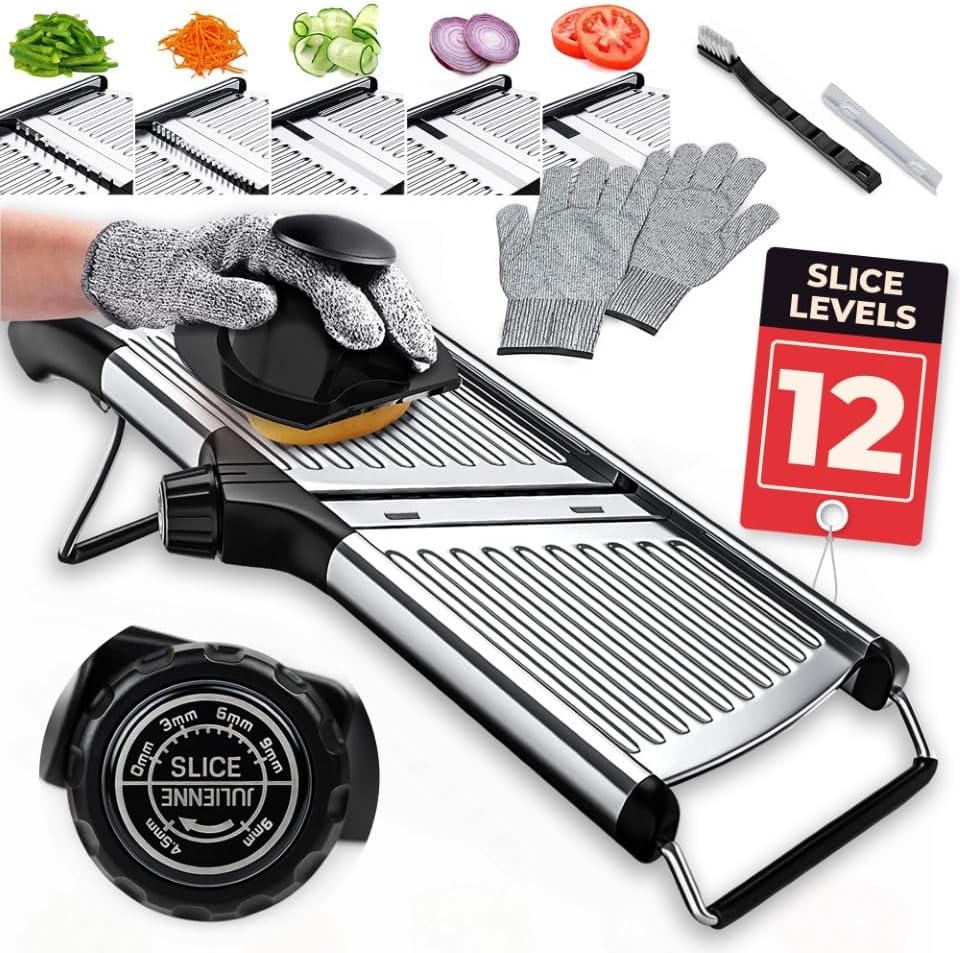
Gramercy Adjustable Stainless Steel Mandoline with Cut-Resistant Gloves
A stainless steel adjustable mandoline with cut-resistant gloves included — a safety-first setup that covers both precision slicing and the hand protection that every mandoline user should have.
Considerations
Gloves are one-size — may not fit all hand sizes with optimal dexterity
Stainless steel surface can be slippery without a damp towel beneath the board
Includes cut-resistant gloves as standard — the most important mandoline safety accessory
Stainless steel construction provides durability across years of regular batch slicing
Adjustable thickness covers the full range from paper-thin to thick-cut slices
Folds compact for drawer storage when not in use
Home fermenters and batch cooks who slice large quantities of vegetables weekly and want a professional-grade mandoline with the safety equipment included from the start.
Put on the cut-resistant gloves before handling the blade. Set your thickness, place over a bowl or container, and pass food firmly through the blade with even, controlled strokes. Never use without hand protection.
Benriner Jumbo Mandoline Slicer Japanese Stainless Steel Blade
The Benriner Jumbo mandoline with a Japanese stainless steel blade — the wide-body professional standard used in Japanese restaurant kitchens, prized for its razor-sharp blade quality and clean, precision cuts.
Considerations
No catch container included — requires positioning over a bowl or crock
Minimalist design provides no hand guard — absolutely requires cut-resistant gloves
Japanese stainless steel blade produces the cleanest, sharpest cuts available in consumer mandolines
Wide jumbo body handles full cabbage quarters and large root vegetables in fewer passes
Simple, durable construction with minimal moving parts that can fail or dull
Professional kitchen provenance means exceptional real-world blade longevity
Experienced fermenters and serious home cooks who prioritize blade quality and cut precision above all else, and who are comfortable using cut-resistant gloves as their primary safety measure.
Always wear cut-resistant gloves before use — no hand guard is included. Position over a large bowl or fermentation crock, set thickness with the dial, and draw the food across the blade with smooth, deliberate strokes.
Note: Immediately after shredding, transfer cabbage to a large bowl and add salt. Massaging the shreds begins brine production immediately, producing better texture in the final ferment.
Buying Guide
Blade Types: Straight, V-Blade, and Ceramic
Mandoline blades fall into three geometries. Straight blades are the most common: a single flat blade edge that food slides across in a single cutting motion. V-blades use two angled blade edges forming a V-shape — this geometry creates a cleaner cut with less cell damage than flat blades, producing less bruising in delicate vegetables. Ceramic blades maintain sharpness exceptionally well and don't react with acidic produce like tomatoes or citrus, but are brittle — they can chip if dropped or if a hard seed is encountered. Japanese stainless steel blades (used in Benriner and similar models) represent the premium standard for single-blade mandolines: exceptionally sharp, slow to dull, and precision-ground for consistency. For fermentation vegetable prep where cut quality directly affects ferment texture, a high-quality stainless or V-blade mandoline produces noticeably superior results.
Adjustable Thickness: What Settings Matter
Thickness adjustment is the mandoline's primary utility — the ability to change from paper-thin 0.5mm cucumber slices to 3mm potato rounds to 5mm zucchini planks covers the full range of home cooking applications. Most consumer mandolines offer between 3 and 5 fixed thickness settings; premium models provide stepless adjustment across a continuous range. For fermentation vegetable work: sauerkraut cabbage is typically sliced at 2–3mm, kimchi daikon at 3–4mm julienne, and fermented cucumber at 2mm. Fixed-setting mandolines cover these needs adequately if the settings align with your typical use. Stepless adjustment is worth the additional investment for cooks who work across a wide range of cooking applications and need precision at any thickness.
Safety: The Non-Negotiable Factor
Mandoline injuries are among the most serious and common kitchen accidents. Emergency room data consistently shows that mandoline cuts are deeper and more severe than typical kitchen knife injuries because the blade is stationary and the user's hand passes repeatedly over it at high speed. Three safety systems are standard across quality mandolines: a hand guard that grips the vegetable with spikes, keeping fingers behind a barrier; cut-resistant gloves that provide backup protection when the hand guard is impractical for small food pieces; and non-slip feet that prevent the tool from moving during use. The FDA's food safety consumer guidance recommends cut-resistant gloves (ANSI Level 5 or equivalent) as essential safety equipment for all mandoline use — not optional.
Cleaning and Storage
Mandoline blades require careful cleaning to prevent corrosion and maintain sharpness. Most mandolines are dishwasher-safe on the top rack — verify before loading, as not all models are. For hand washing, use a brush (never a cloth or sponge that could snag on the blade edge) with warm soapy water, directing brush strokes away from the blade cutting edge. Dry thoroughly immediately after washing to prevent rust on carbon steel blades. Store mandolines with blade guards installed or in their provided cases to prevent accidental contact with the exposed blade when reaching into storage. Multi-blade models require careful organization of blade inserts — a dedicated storage bag or case keeps them organized and protects their edges.
Traditional sauerkraut uses 2–3mm shreds — thin enough to ferment efficiently and produce a tender final texture, thick enough to retain some structure after weeks in brine. For a softer, more restaurant-style texture, use 1.5–2mm. For crunchier, heartier kraut, use 3–4mm. Experiment to find your preference — shred width is one of the most impactful variables in sauerkraut texture, and the difference between 2mm and 4mm is noticeable in the finished product.
A mandoline is safe for beginners when used with the correct equipment and technique: always use the included hand guard or food holder, always wear cut-resistant gloves as backup protection, and stop slicing when the food piece becomes small enough that your hand approaches the blade — use the knife to finish or discard the stub. A handheld mandoline with an ergonomic handle and a good hand guard is the most beginner-friendly entry point before progressing to full board-style models.
Yes — most mandoline sets include a julienne blade insert that creates matchstick cuts for daikon, carrots, zucchini, and other vegetables. Traditional kimchi calls for daikon julienned at approximately 3mm square. Select the julienne attachment, set the thickness, and process the vegetable as normal. For very long vegetables like daikon, cut into manageable sections first to maintain control during slicing.
Use a dedicated brush (bottle brush or pastry brush) with warm soapy water. Never use a cloth or sponge that can snag on the blade teeth. Brush from the spine of the blade toward the edge rather than against it. For dishwasher cleaning, place blade inserts in the dishwasher basket with the sharp edges facing down and away from other items. After washing, handle blades with a folded cloth or kitchen towel rather than bare hands.
A mandoline slices food to a consistent thickness using a stationary blade that food passes over. It excels at thin, uniform slices and julienne cuts, but does not dice. A food chopper uses a pushing motion to force food through a grid of blades, producing diced or chopped pieces. Many products combine both functions in one unit — a hinged chopping grid for dicing with a mandoline attachment underneath for slicing. Combination units are space-efficient but generally sacrifice some precision compared to dedicated tools.
Unclean cuts usually indicate a dull blade, food debris between the blade and the adjustment mechanism, or food being pressed at an inconsistent angle. First, remove and inspect the blade for visible dulling or damage. Clean thoroughly around the blade channel and adjustment screws where food can pack and interfere with blade position. Ensure you're pressing food firmly and evenly across the full width of the blade in a single smooth stroke. Most consumer mandoline blades are not user-sharpenable — replace the blade insert when performance degrades.
Our Recommendation
For most home cooks, our Best Overall pick — Mueller Pro-Series 12-Blade Mandoline Slicer with Container — offers the best balance of performance, reliability, and value. If budget is a priority, our Best Value pick — Fullstar 8-in-1 Vegetable Chopper & Mandoline with Container — delivers excellent results at a lower investment. Experienced cooks who want maximum performance should consider our Editor's Pick — Mueller Vegetable Chopper Mandoline with Container.